

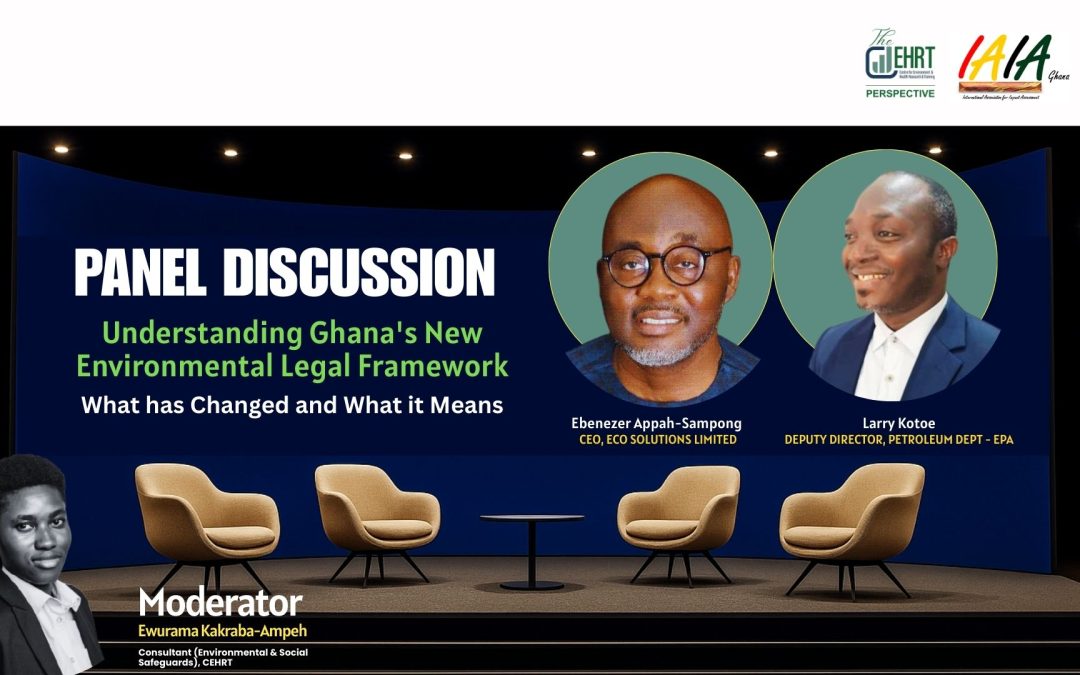
The CEHRT Perspective hosted its final panel discussion of the year in partnership with IAIA.GH – the Ghana Chapter of the International Association for Impact Assessment – bringing together regulators, practitioners and stakeholders to unpack the major reforms shaping Ghana’s environmental governance landscape and to explore how institutions and project proponents can strategically adapt.
The webinar, themed Understanding Ghana’s New Environmental Legal Framework: What Has Changed and What It Means, focused on recent updates to Ghana’s environmental legal and regulatory regime, particularly the Environmental Protection Act, 2025 (Act 1124) and the Environmental Assessment Regulations, 2025 (L.I. 2504). Discussions centred on the intent of the reforms, implementation readiness and the implications for project development and environmental governance.
The session was moderated by Ewurama Kakraba-Ampeh and featured a panel comprising Mr Ebenezer Appah-Sampong, Former Deputy Executive Director of the Environmental Protection Agency and Chief Executive Officer of Echo Solutions, and Mr Larry Kotoe, Deputy Director at the Environmental Protection Agency (EPA).
A technical presentation was delivered by Mr Kwabena Kwakye, who provided an overview of Ghana’s environmental protection and environmental assessment framework. He traced the evolution of the system from the EPA Act, 1994 (Act 490) and the Environmental Assessment Regulations, L.I. 1652, to the newly enacted Act 1124 and L.I. 2504. He highlighted key reforms, including the expanded scope of environmental assessment, the integration of climate change, biodiversity and social risk considerations, strengthened public participation requirements, the introduction of strategic environmental assessment, administrative penalties, and the regulation and certification of environmental practitioners.
The ensuing panel discussion examined the practical implications of the new framework. Mr Larry Kotoe outlined the EPA’s readiness to operationalise the reforms, noting increased decentralisation, staff capacity strengthening, and the digitalisation of permitting processes. He also explained the introduction of a two-phase permitting system, separating construction permits from operational permits, and addressed issues of data protection within environmental impact assessments, particularly the management of sensitive personal information related to compensation and resettlement.
Mr Ebenezer Appah-Sampong provided broader policy and governance perspectives on Act 1124, emphasising the law’s strengthened enforcement powers, clearer sanctions, improved appeals mechanisms and its potential to enhance environmental governance by reducing political interference and improving regulatory compliance.
Further discussions addressed the certification and professional regulation of environmental practitioners, coordination between the EPA and other permitting authorities, screening of projects in environmentally sensitive areas, the treatment of corporate social responsibility initiatives within the regulatory framework, and the alignment of Ghana’s environmental laws with international climate and biodiversity commitments.
The webinar concluded with an engaging question-and-answer session, underscoring the need for project proponents, consultants and institutions to proactively adapt to the revised legal requirements, strengthen internal environmental management systems and engage early with the EPA to ensure compliance under Ghana’s new environmental legal framework.